For anyone shopping for natural supplements in Singapore, the word "natural" appears on almost every shelf and listing — yet it carries no standardised legal definition in most supplement markets. This guide unpacks what the term actually signals, what it does not guarantee, and how to read a label more carefully before deciding.
What "natural" usually means on supplement labels
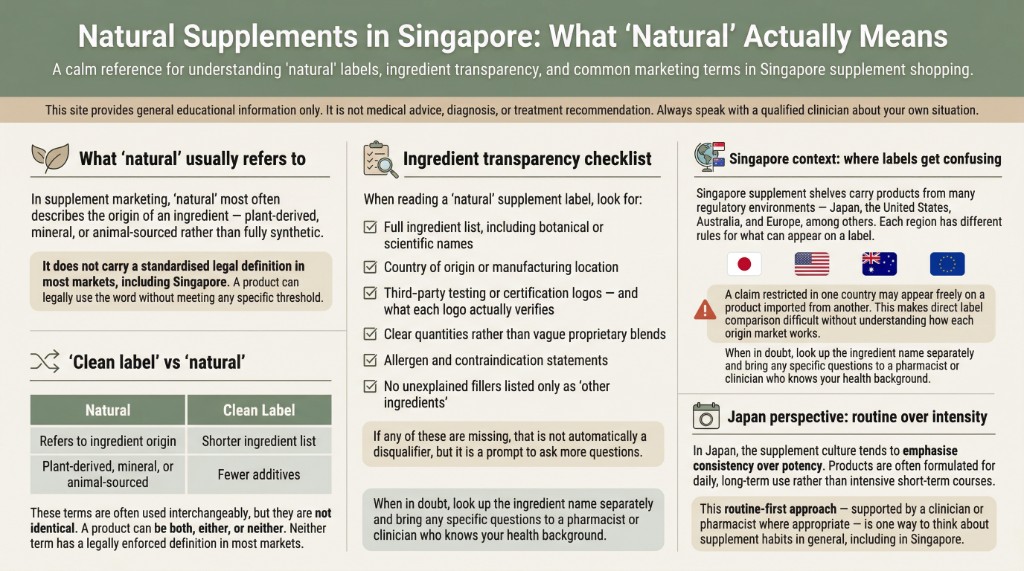
On a supplement label, "natural" most often describes the origin of an ingredient — derived from a plant, mineral, or animal source rather than produced through full chemical synthesis. It does not mean the product is safe, effective, or free from processing.
A few things "natural" on a label does not tell you:
- Whether the ingredient has been heavily processed after extraction
- Whether the quantity used is meaningful
- Whether the product has passed third-party testing
- Whether it is suitable for your individual health situation
When you see "natural" on natural health products in Singapore, treat it as a starting point for further questions rather than a final answer.
Clean label vs natural vs herbal
These three terms are often used interchangeably, but each has a distinct meaning:
Natural refers to ingredient origin. A product can call itself natural regardless of how many additives, binders, or fillers it contains, provided the primary ingredients come from natural sources.
Clean label is a marketing phrase, not a regulated standard. It typically describes a product with a shorter ingredient list and fewer synthetic additives. There is no certification body that defines when a label becomes "clean".
Herbal supplements in Singapore are a specific category of natural health products that use plant-derived active ingredients — roots, leaves, bark, or extracts. Herbal does not automatically mean safe or mild; some botanical ingredients interact with medications or are contraindicated in certain health conditions.
Knowing the difference helps you ask better questions. A product labelled "herbal and natural" may still contain synthetic excipients. A "clean label" product may not have disclosed all processing steps.
Ingredient transparency checklist
When reading a natural supplement label in Singapore, work through this list:
- Full ingredient list present? Including botanical or scientific names, not just common names
- Amounts disclosed? Specific quantities for each active ingredient, rather than proprietary blends that hide individual levels
- Country of origin or manufacture stated? Products sold in Singapore come from multiple regulatory environments; each has different labelling rules
- Third-party certification logos? If present, check what each logo actually certifies — contaminant testing differs from potency verification
- Allergen and contraindication statements? Clear language about who should not take the product
- No vague "other ingredients"? Unexplained fillers or carriers should prompt further investigation
Ingredient transparency matters because the same active compound can appear in a well-studied form or a poorly absorbed form. The label is often the only tool you have before purchase.
Additives and terminology limits
"Additive-free" is a common marketing claim on supplement packaging. It has no enforced legal definition for supplements in most markets. In practice it usually means the product does not contain certain synthetic colours, sweeteners, or preservatives — but the scope of what counts as an "additive" is decided by each manufacturer.
Similarly, terms like "chemical-free" are technically inaccurate — every substance, including water, is a chemical. When a label uses this phrase, it signals a marketing tone rather than a factual claim.
Some additives serve legitimate functional roles: preventing moisture, improving shelf stability, or helping ingredients bind together safely. The relevant question is not whether additives exist, but whether each one is identified and whether any pose a concern given your own health background.
If a label relies heavily on additive-free claims while giving minimal detail about active ingredient quantities, that imbalance is worth noting.
Organic vs natural supplements singapore
"Organic" and "natural" are related but distinct terms, even when both appear on the same product.
Organic refers to how an ingredient was grown or raised — without synthetic pesticides, herbicides, or (for animal products) certain growth inputs. Organic certification is a process overseen by a certifying body and involves documentation. The most common international standards are USDA Organic (US) and EU Organic. Singapore does not have its own organic certification standard for supplements.
Natural refers only to origin, as described above. An organic ingredient is natural by definition, but a natural ingredient is not automatically organic.
For Singapore buyers, this means:
- A product labelled "natural" may not meet any organic standard
- A product labelled "organic" has passed third-party auditing for farming practices, but this does not speak to potency, bioavailability, or clinical relevance
- Both terms describe inputs and processes, not outcomes
Neither label alone is a reliable proxy for quality. A fuller picture requires reading the ingredient list, checking certifications individually, and if needed, consulting a clinician or pharmacist.
How Singapore regulates health supplements
In Singapore, health supplements are regulated by the Health Sciences Authority (HSA) under the Health Products Act. Unlike pharmaceutical drugs, most health supplements do not require pre-market approval from HSA before they can be sold. Instead, they operate under a post-market regulatory framework: importers and manufacturers are responsible for ensuring their products are safe and that labelling is accurate and not misleading.
This regulatory structure means the word "natural" on a supplement label sold in Singapore is a marketing descriptor, not an HSA-defined or HSA-verified claim. HSA's labelling guidelines prohibit health claims that imply a supplement can treat or cure a disease, but terms like "natural", "clean label", or "herbal" are marketing language that falls outside any standardised definition enforced by the authority.
For consumers, this means the burden of evaluation largely rests on reading labels carefully, checking certifications independently, and asking a pharmacist or clinician when uncertain about a specific product or ingredient.